
The Complete Guide to Ordering a Promotional T-Shirt for Your Australian Business
Learn how to order the perfect promotional t-shirt in Australia — from fabric and decoration to MOQs, budgeting, and artwork tips.

Written by
Cleo Wright
Custom Apparel
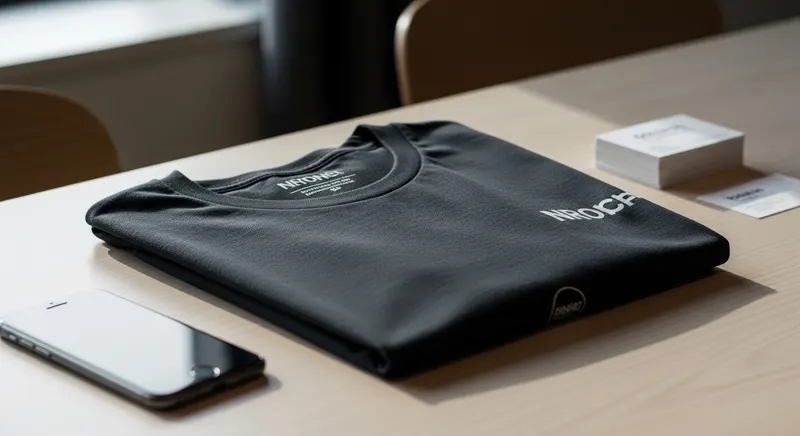
Few branded items deliver the kind of long-lasting visibility that a well-designed promotional t-shirt can achieve. Whether you’re kitting out your team for a trade show in Melbourne, handing out merch at a Gold Coast sporting event, or rewarding loyal customers with something genuinely wearable, a custom t-shirt is one of the most cost-effective promotional products available. Done right, it becomes a walking billboard — worn again and again, far beyond the event it was created for. Done poorly, it ends up at the back of a drawer. This guide walks you through everything you need to know to get it right.
Why the Promotional T-Shirt Remains a Marketing Staple
Marketing teams across Australia continue to invest in custom t-shirts for one simple reason: they work. A quality branded tee gets worn in public, shared on social media, and kept for years. Unlike a flyer that gets binned or a digital ad that disappears after a scroll, a promotional t-shirt keeps your brand front and centre in the real world.
They’re also remarkably versatile. A Brisbane sporting club might order them as part of a uniform package. A Sydney tech startup could use them as onboarding gifts for new staff. A Perth council might hand them out at a community fun run. Across all these scenarios, the t-shirt functions as both a practical garment and a brand ambassador.
The numbers back this up too. Promotional apparel consistently ranks among the most recalled categories of branded merchandise, with wearable items achieving far greater brand impressions per dollar than almost any other format. For marketing teams working with tight budgets, that kind of return on investment is hard to ignore.
Choosing the Right Fabric for Your Promotional T-Shirt
Before you think about colours, logos, or quantities, the first decision you need to make is fabric. The material determines how the finished product looks, feels, and wears — and it has a direct impact on which decoration methods are suitable.
Cotton
100% cotton is the classic choice. It’s breathable, comfortable, widely available, and tends to accept screen printing and heat transfer very well. For events in Queensland or the Northern Territory where heat and humidity are factors, cotton’s breathability is a genuine advantage. The trade-off is that pure cotton can shrink slightly after washing and may not hold vivid colours as well as synthetic blends.
Polyester and Performance Blends
For sporting clubs and active events, polyester or cotton-polyester blends are often a better fit. These fabrics wick moisture away from the skin, dry quickly, and hold colour extremely well — making them ideal for sublimation printing, which allows for full-colour, edge-to-edge designs. A Sydney fitness studio ordering custom training tees for members would almost certainly benefit from a performance fabric.
Eco-Friendly Options
Organic cotton and recycled fabric t-shirts are increasingly popular, particularly for brands that want their merchandise to reflect sustainability values. These options typically carry a slightly higher unit cost but align well with corporate social responsibility commitments and resonate strongly with environmentally conscious audiences.
Decoration Methods: Which One Is Right for Your Design?
Getting your branding onto the garment is where things get technical — and where a lot of first-time buyers make costly mistakes. Understanding the major decoration methods will help you choose the right approach for your design and budget.
Screen Printing
Screen printing is the most common method for promotional t-shirts, and for good reason. It produces vibrant, durable results at a low cost per unit when ordering in volume. The setup involves creating a separate screen (or stencil) for each colour in your design, which is why setup fees apply and why screen printing becomes more economical as quantities increase.
Typical MOQs for screen printing start around 20–50 units, though many suppliers will accommodate smaller runs with a higher per-unit cost. For orders of 100 or more — common for conferences, school events, or team uniforms — screen printing is almost always the most cost-effective choice.
One important consideration: screen printing works best with bold, simple designs and limited colours. If your logo uses more than four or five colours, costs can escalate quickly. Before finalising your design, check out our guide to creating effective t-shirt graphics for tips on optimising artwork for print.
Heat Transfer
Heat transfer involves printing a design onto a transfer film and then pressing it onto the fabric with heat. It’s a flexible option for smaller runs and complex, multi-colour artwork. It’s not quite as durable as screen printing over the long term, but for promotional tees that don’t need to withstand years of heavy washing, it’s a perfectly practical solution.
Sublimation
Sublimation is best suited to polyester fabrics and allows for full-colour printing across the entire garment — including seams and sleeves. It’s a great option for sporting clubs wanting bold, all-over designs. The downside is that it doesn’t work on cotton, and it typically has higher unit costs for smaller runs.
Direct-to-Garment (DTG)
DTG printing works similarly to a standard inkjet printer but on fabric. It excels with photographic images and complex artwork, and it’s well-suited to low-quantity or one-off orders. For marketing teams wanting personalised tees for a small executive team or VIP clients, DTG can be a strong option.
Getting Your Artwork Ready
Artwork is one of the biggest stumbling blocks in the promotional t-shirt ordering process. Many buyers arrive with a logo saved from a website — a low-resolution PNG or JPEG — only to discover it can’t be used for print without significant rework.
For screen printing and most other decoration methods, you’ll need a vector file (typically an .ai or .eps file from Adobe Illustrator). Vector files can be scaled to any size without losing quality, which is essential for garment decoration. If you’re unsure what file format your logo is in, read our explanation of what a vector art file is before you place your order.
Your supplier will typically provide a digital proof for approval before production begins. Understanding the difference between a virtual proof and a physical sample is also worth knowing — our post on virtual proofs vs physical samples for promotional products breaks down when to request each and why it matters.
Planning Your Order: MOQs, Timelines, and Budgets
Minimum Order Quantities
MOQs vary significantly depending on the supplier and decoration method. Screen printing typically requires at least 20–50 units to be cost-effective, while DTG and heat transfer can often accommodate runs of just a handful of items. If you’re ordering for a large event — say, a 500-person conference in Adelaide or a school sports carnival in Canberra — you’ll almost certainly benefit from volume pricing tiers that kick in at thresholds like 50, 100, 250, and 500 units.
Turnaround Times
Standard production turnaround for promotional t-shirts in Australia typically runs between 7 and 14 business days from proof approval, depending on the supplier and order complexity. Rush orders are often possible for an additional fee, but it’s always better to plan ahead. If you’re ordering for a specific event, build in at least three to four weeks from the moment you begin briefing your supplier.
Budget Considerations
Per-unit costs for a basic screen-printed promotional t-shirt in Australia can range from as little as $8–$10 for large bulk orders to $25–$35 or more for premium fabrics with complex decoration. Setup fees (typically $50–$150 per colour for screen printing) are an additional consideration, particularly for smaller orders where they represent a larger portion of the total cost.
Pairing Your T-Shirts With Other Branded Merchandise
A promotional t-shirt rarely travels alone. Marketing teams and event organisers often bundle them with complementary products to create a stronger brand impression. Some popular combinations include:
- Tote bags: Great for conferences and expos — explore custom tote bags and branded bags to find the right match for your event
- Branded caps and polo shirts: For a consistent team look, consider pairing tees with custom work polo shirts for staff-facing roles
- Wristbands: Events and festivals often combine t-shirts with wristbands for events for a cohesive attendee experience
- Water bottles: A branded tee paired with a quality drink bottle makes a compelling welcome pack — our guide to the best water bottle brands for promotions can help you choose wisely
For seasonal campaigns, it’s also worth thinking about how your t-shirt order fits into a broader merchandise strategy. If you’re planning ahead for the cooler months, our post on winter promotional products in Sydney has some helpful ideas for rounding out your apparel range.
Common Mistakes to Avoid
Even experienced marketing teams can trip up when ordering promotional t-shirts. Here are the pitfalls most worth avoiding:
Ordering too few (or too many). Underestimating demand leaves people without a tee; overestimating leaves you with boxes of stock. Get a firm headcount before you order, then add a small buffer of 5–10% for last-minute additions.
Ignoring sizing distribution. Australian workplaces and communities include a wide range of body types. Order a realistic spread across sizes — typically weighted toward M, L, and XL — rather than defaulting to a one-size-fits-most approach.
Approving without checking colour accuracy. PMS (Pantone Matching System) colour codes are the most reliable way to specify exact colours. Don’t rely on how a colour appears on your screen — it may look very different when printed.
Leaving artwork too late. Back-and-forth on artwork revisions is one of the most common causes of order delays. Have your vector files ready and your design locked in before you approach a supplier.
Conclusion: Key Takeaways for Your Next Promotional T-Shirt Order
A promotional t-shirt is one of the smartest investments a marketing team, business, or sporting club can make — but the difference between a successful order and a disappointing one comes down to preparation and knowledge. Here are the most important points to carry with you:
- Choose your fabric first — match the material to the end use, whether that’s a corporate event, sporting competition, or customer giveaway
- Understand your decoration options — screen printing suits high-volume, simple designs; DTG and heat transfer work better for small runs and complex artwork; sublimation is ideal for sportswear
- Prepare your artwork correctly — always supply vector files and confirm colour codes before production begins
- Plan your timeline realistically — allow at least three to four weeks end-to-end, including proof approval and delivery
- Bundle strategically — a promotional t-shirt is even more powerful when paired with complementary branded products like backpacks and totes, event wristbands, or branded umbrellas to create a complete merchandise experience
With the right planning, your next promotional t-shirt order can do far more than fill a goody bag — it can genuinely extend your brand’s reach every single day it’s worn.