
The Complete Guide to Choosing a Promotional USB Stick for Your Brand
Discover how to choose the right promotional USB stick for your business, from storage sizes and decoration methods to MOQs and budget tips.

Written by
Benji Taylor
Tech & Electronics
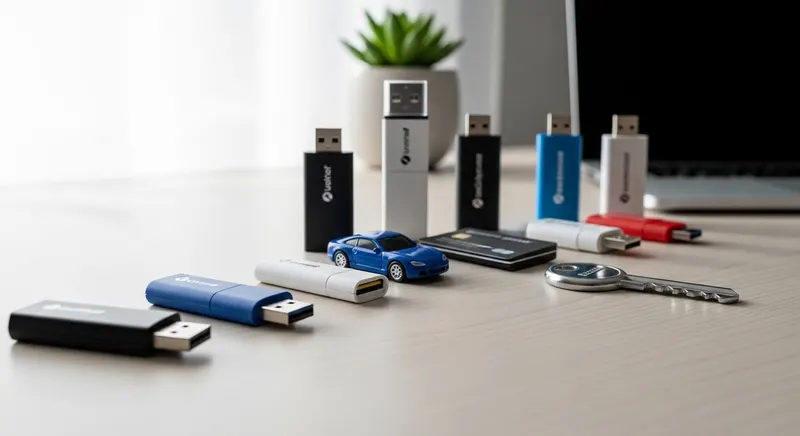
Every marketing team eventually faces the same question: what branded giveaway will people actually keep and use? In a world overflowing with branded pens and tote bags, a promotional USB stick manages to punch well above its weight. It’s practical, portable, and — perhaps most importantly — it lands on desks and in laptop bags rather than rubbish bins. Whether you’re planning a product launch in Melbourne, a trade show in Sydney, or a corporate conference on the Gold Coast, a well-chosen USB stick delivers ongoing brand visibility that few other promotional products can match. This guide walks you through everything you need to know before placing your order.
Why a Promotional USB Stick Still Works in 2026
It’s tempting to assume USB drives have been made obsolete by cloud storage. In reality, they remain one of the most universally useful tech accessories across Australian workplaces, schools, and industries. Healthcare professionals, tradies, engineers, educators, accountants — all of them regularly move files between systems that aren’t connected to the same cloud environment. USB drives solve a very real problem.
From a marketing perspective, the numbers are compelling. Unlike a flyer that gets recycled within hours, a branded USB stick is kept and used repeatedly. Every time someone plugs it into a laptop, your logo appears. That’s earned brand exposure that compounds over months and sometimes years.
There’s also the novelty factor. When you choose a creatively shaped or premium-feel USB, it becomes a conversation piece. Your brand isn’t just visible — it’s memorable. If you’re interested in exploring quirky and creative options, our guide to novelty USB flash drives breaks down some of the most popular fun formats available for Australian businesses.
Understanding Storage Capacity and What It Means for Your Budget
Before you get into shapes and colours, start with the basics: how much storage do you actually need?
Common Capacity Options
USB sticks for promotional use typically come in the following capacities:
- 2GB – Entry-level; suitable for simple document distribution or basic brand files
- 4GB – A popular mid-range option; comfortable for brochures, videos, and presentations
- 8GB – Great for media-rich content packs, event kits, or product catalogues
- 16GB – Suitable for larger file sets, software, or when you want the recipient to keep using the drive long-term
- 32GB and above – Premium gifting tier; ideal for high-value clients or executive-level corporate gifts
As a general rule, go for at least 8GB if your primary goal is for recipients to keep using the drive after they access your pre-loaded content. The small price difference between 4GB and 8GB is negligible at bulk quantities, but the perceived value to the recipient is noticeably higher.
Pre-Loading Content
One of the most underutilised features of promotional USB orders is pre-loading. Many Australian suppliers will load your files directly onto the drive before dispatch. This is excellent for:
- Conference presenters distributing slide decks and resources
- Real estate agencies sharing property listings and virtual tours
- Event organisers providing attendee information packs
- Product launches including demo videos or spec sheets
If you plan to pre-load content, factor in the data size early — it affects which capacity you’ll need to order.
Choosing the Right Shape and Style
This is where the fun begins. USB sticks come in a truly remarkable range of formats, and your choice of shape communicates a great deal about your brand.
Standard Card and Swivel Styles
Classic swivel USBs and slim credit card-style drives are popular for professional environments. They feel premium, sit flat in a wallet or card holder, and are easy to customise with full-colour printing or laser engraving. A Brisbane accounting firm or a Perth government department would typically lean toward these styles — clean, functional, and corporate-appropriate.
Novelty and Custom-Shaped USBs
Custom-moulded USBs can be made in virtually any shape: a miniature version of your product, your mascot, a car key, a house, a tool — the options are broad. These are particularly effective for trade shows and expos where you need your giveaway to stand out from a crowded merchandise table. They’re also popular in retail, real estate, and consumer-facing businesses where personality counts.
For a deeper look at what’s available in the novelty space, check out our overview of promotional USB drives and what to look for before committing to a shape.
Wood and Eco-Friendly USB Options
With sustainability increasingly important to Australian consumers and B2B clients alike, eco-friendly USBs made from bamboo or recycled materials are worth considering. They look premium, feel tactile, and tell a story about your brand values. An Adelaide not-for-profit or a Canberra government agency sourcing merchandise for a sustainability campaign would find these especially fitting.
Decoration Methods: How Your Logo Gets On There
The decoration method you choose affects both the look of the finished product and the cost. Here’s a breakdown of what’s typically available:
Laser Engraving
Best suited to metal and wood USB sticks. Laser engraving removes the surface material to reveal the material beneath — usually a lighter tone or the raw material. The result is a permanent, high-end finish that looks exceptional on executive gifts. No risk of the logo fading or peeling over time.
Pad Printing
The most common method for plastic USB sticks. Pad printing is cost-effective and works well for simple logos with limited colours. For most standard corporate orders, pad printing delivers a clean and professional result without adding significantly to the unit cost.
Dome Printing and Full-Colour Digital Printing
For USBs with a larger print surface — like card-style or oversized swivel drives — full-colour digital printing allows detailed, high-resolution artwork to be applied. This is ideal when your branding includes photographic elements or complex gradients. If your artwork isn’t already in vector format, make sure you read our explainer on what a vector art file is and why it matters for print quality before submitting your order.
Embossed or Debossed Logo Areas
Some USB housings are manufactured with a recessed or raised panel specifically designed for logo placement. These work well for custom-moulded novelty shapes where the logo sits cleanly in a dedicated zone.
Minimum Order Quantities, Turnaround Times, and Budgets
Understanding the practical side of ordering prevents costly surprises.
Minimum Order Quantities (MOQs)
For promotional USB sticks in Australia, MOQs typically start at 50 units for standard shapes, though some suppliers require 100 units as a minimum. Custom-moulded novelty shapes usually have higher MOQs — often 500 units or more — because the mould creation adds to upfront costs.
If you’re ordering for a small team event or a pilot campaign, stick with standard shapes at lower quantities. Reserve the custom moulds for large-scale campaigns where the volume justifies the investment.
Turnaround Times
Standard USB orders typically take 10–15 business days from artwork approval to delivery. If you’re ordering custom-moulded shapes from offshore manufacturing, allow 4–6 weeks, particularly if you need a physical sample approved first. Always build in buffer time when working toward a fixed event date.
Speaking of samples, it’s worth understanding the difference between virtual proofs and physical samples before you lock in your order — our detailed comparison of virtual proofs vs physical samples for promotional products explains when each approach is appropriate.
Budget Considerations
At standard bulk quantities, here’s a rough guide to per-unit pricing:
- 50–100 units: $8–$18 per unit (depending on capacity and style)
- 250–500 units: $5–$12 per unit
- 500+ units: $3–$8 per unit
Setup fees for pad printing typically add $50–$80 per colour. Laser engraving setup is usually a flat fee around $50. Pre-loading data may add a per-unit charge depending on file size and complexity.
Pairing USB Sticks with Other Promotional Products
A USB stick works beautifully as part of a broader merchandise pack. For conferences or product launches, consider pairing it with:
- A branded notebook or pen — check out our guides on wristbands for events and event wristbands if you’re also managing access control or ticketing
- A branded tote bag or backpack as the pack carrier
- A branded keep cup or water bottle for an elevated welcome gift
For seasonal campaigns in cooler months, combining a USB stick with items from our rundown of winter promotional products in Sydney creates a cohesive, well-thought-out gift pack. Similarly, if you’re planning end-of-year staff gifts, our roundup of Christmas gift ideas for employees includes USB sticks among a wider selection of practical options.
Signage at your event or trade show stand matters too — a well-designed teardrop banner displaying your brand keeps your booth looking professional while visitors pick up their branded USB giveaways.
Common Mistakes to Avoid
Even experienced marketing teams make avoidable errors when ordering promotional USB sticks. Here are the most common:
- Ordering too low a capacity to save money — recipients often discard drives that fill up too quickly. The cost saving isn’t worth the reduced lifespan of your branding.
- Submitting low-resolution artwork — always supply vector files or high-resolution originals. Poor artwork leads to blurry logos and rejected proofs.
- Ignoring USB compatibility — confirm whether your audience uses USB-A, USB-C, or needs a dual-port drive. Australian workplaces are increasingly moving to USB-C, particularly on newer MacBooks and tablets.
- Not proofing pre-loaded content — request a test drive with your content loaded before approving the full run. File corruption or layout errors on 500 units is an expensive mistake.
- Cutting the timeline too fine — allow at minimum three weeks for standard orders, more for anything custom or offshore-manufactured.
Conclusion: Key Takeaways for Your Next Promotional USB Order
The promotional USB stick remains one of the most practical and enduring branded tech items available to Australian marketing teams. It crosses industries, age groups, and professional contexts with ease — making it a reliable choice whether you’re running a corporate event in Hobart, a sports club fundraiser in Darwin, or a national trade show campaign.
Here are the key points to carry with you:
- Choose storage capacity based on the recipient’s likely use, not just the immediate campaign need — 8GB is a safe, practical starting point for most audiences
- Match the shape and style to your brand personality — card and swivel styles suit corporate audiences, while novelty shapes make a bigger impact at consumer-facing events
- Select the right decoration method — laser engraving for premium, pad printing for budget-friendly, full-colour digital for complex artwork
- Plan your timeline carefully — standard orders need 10–15 business days; custom shapes from offshore manufacturing need 4–6 weeks
- Consider USB-C compatibility if your audience uses newer devices, and always proof your pre-loaded content before approving the full production run
A well-chosen, well-branded promotional USB stick is far more than a giveaway — it’s a tool that carries your brand into daily working life, long after the event is over.